
Day 3-4: The Africa time zone
Patience is a virtue
Author
Author
We finished up our time at Samburu and drove to Ol Pejeta today. A few minor inconveniences/delays, which I of course arranged so that the guests would get a more authentic African experience.
Before I get to that, a few more Samburu notes. This time, I’ve decided to earn my keep a little bit more and give a few lectures on Kenyan history, politics, and culture. I gave the group a book list in advance, and most of them are actually reading the key one, Michaela Wrong’s It’s Our Turn To Eat, the story of a whistle blower in the Kibaki government (2003-2013) who blew the lid on a major corruption scandal. Wrong uses that story to delve into Kenya’s history and politics more broadly. Excellent read.
The other books, which I don’t think anyone’s read (didn’t expect anyone to) are Jomo Kenyatta’s Facing Mt. Kenya, an anthropology of the Kikuyu culture (Kenya’s largest tribe); The River Between, a novel by Ngugi wa Thiong’o about the impact of colonialism and Christianity on the Kikuyu; and David Anderson’s Histories of the Hanged, about the Mau Man era/Kenya’s independence struggle.
The first lecture was about Kenya’s geography, pre-colonial history, and Kikuyu culture. Moses, who is Kikuyu, came and was kind enough to contribute. I must say it felt more than a little awkward talking about his community in front of him, but he was very supportive and complimentary (this is not something he wanted to do on his own, otherwise I would have ceded it all to him).
I think the most poignant detail about the Kikuyu as pertains to colonialism is that their incredible hospitality, which I have experienced so much of over the years, turned out to be their achilles heel. Kikuyu have a land tenure system based loosely on private property, at least for family groups, but it includes a practice of allowing landless people, usually members of a clan that has outgrown its land, to cultivate a section of land for free. According to Kenyatta, when the British came and wanted Kikuyu land, the Kikuyu welcomed them on this basis, not imagining they would permanently take it from them.
We ended our time in Samburu with our usual sundowner happy hour, but in a different location this time. It was spectacular.
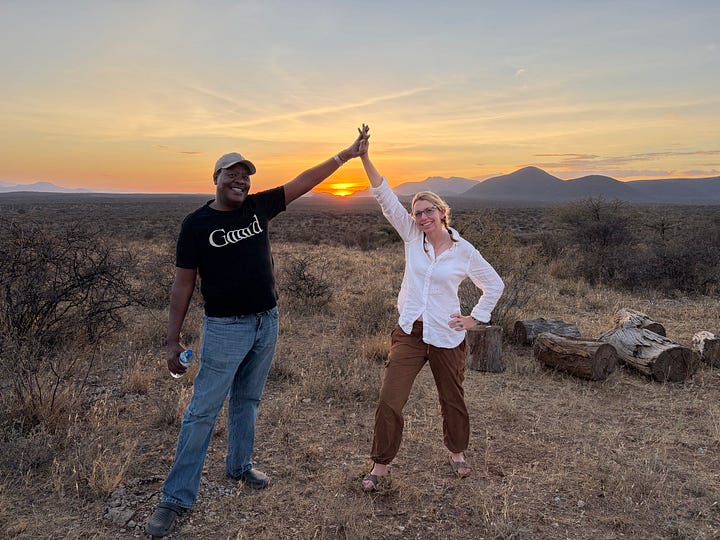
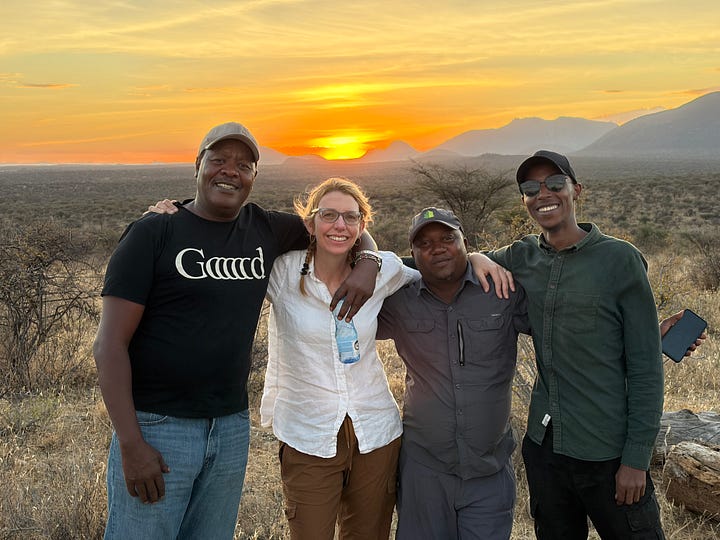
OK, onto the various delays. We left after breakfast this morning, and I told the group it was an easy 3 hour drive to our next location. Everyone was very happy to hear this news. Mt. Kenya was once again clearly visible all the way from our lodge for about two hours. Glorious.
Delay #1: One of the car’s clutch got stuck. We had to circle back to help them, and I held my breath. Fortunately, Moses fixed it in about five minutes.
Delay #2: A transportation inspection stop. This was a new one for me. Apparently the idea is to ensure vehicles are roadworthy and drivers are licensed properly. The inspectors wore vests announcing that the project is funded by the EU. They entered each of the cars’ and drivers’ numbers into the system, and all checked out, except for Moses’s car’s entry did not list the registration of a speed governor (this is a device all commercial vehicles must have to ensure they cannot go over a certain speed). Moses assured them he did indeed have one on his car, but they had to actually lay eyes on it to let us go. That took about 30 minutes, maybe more. Thank you, EU.
Delay #3: This involved a (scheduled) bathroom stop at a very large curio shop, which of course is far too enticing for the shoppers to resist. I totally support the shoppers, I am definitely one of them. But as a tour leader, I’ve never figured out a system to balance the needs of the shoppers with the non-shoppers. It’s like pastoralists and agriculturalists, they are fundamentally at cross purposes, and somebody’s going to be annoyed. You mainly hope to prevent violence.
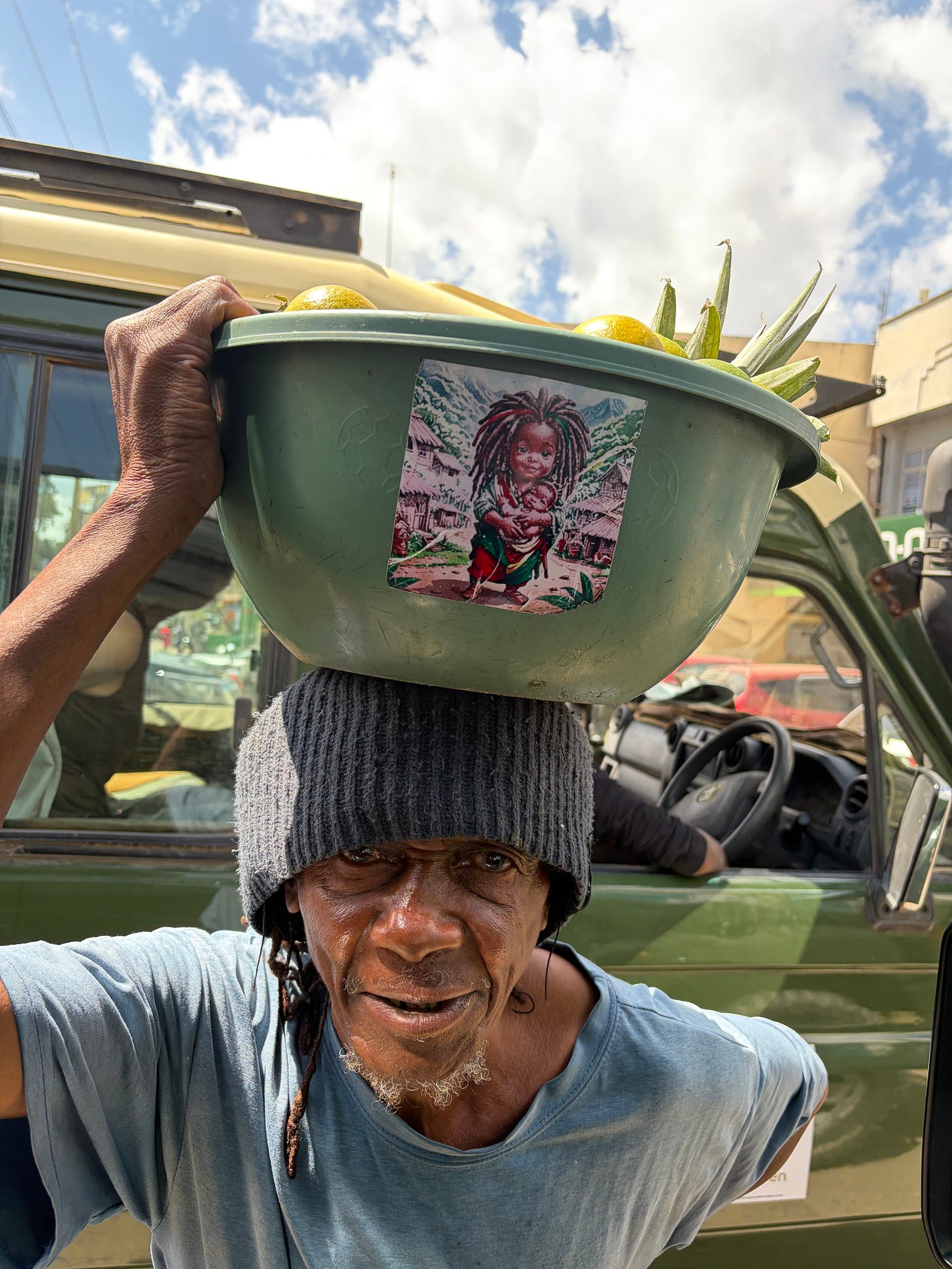
Delay #4: One member of the group wanted to buy stamps at the post office in order to mail postcards. Those who know Africa will not be surprised to hear that this was not a quick in-and-out operation. The good news is I had a lovely conversation with a glue-sniffing teen named Kevin and an elderly fruit vendor named Maina, who insisted I take his picture. 1
Delay #5: Moses needed to get gas. Had we known that the post office was going to take 20 minutes (which was entirely predictable of course), he could have done that while our guest was buying stamps. But that’s not what happened. And those who know Africa will not be surprised to hear that getting gas is not a quick in-and-out operation.
All told, what I had promised would be a 3 hour drive ended up being a 5 hour drive. We once again had a very late lunch. We’ve had a few very late meals, and some very hungry guests, so this time, I handed out almost to full depletion my snacks to keep everyone happy.
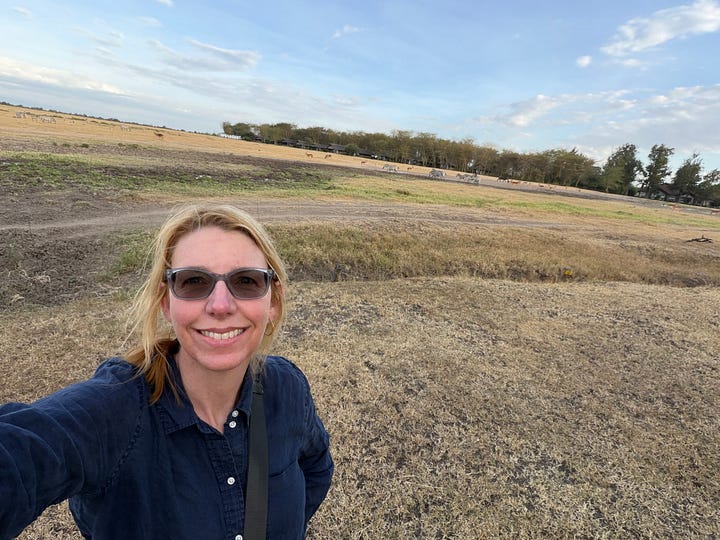
That seemed to work well, as did our arrival at the incredible Sweetwaters camp in Ol Pejeta. The staff here all know me and are the best of the best. And the water hole was very helpfully full of game—zebras, buffalo, water buck, impala, and a rhino.
This evening I stayed behind while the group went out, because old, dear friends of my family who live nearby came to have coffee. So lovely to catch up. Hopefully my absence on the game drive guarantees the group sees something ridiculous like a leopard kill.
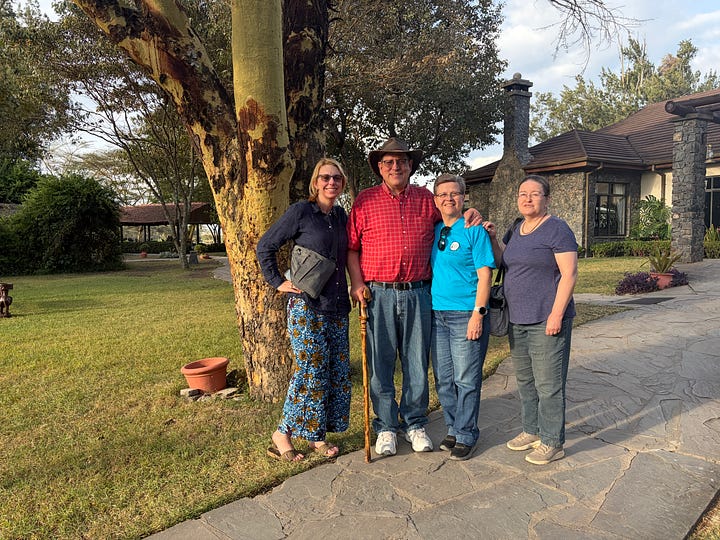
Every trip here is a study in cultural differences regarding time. Americans really do love knowing and sticking to a schedule. Africans….not so much. And that’s not because they are lazy or inefficient or disorganized. It’s because they are used to things going awry. Africans operate from the assumption that they aren’t in control. Americans live orderly, controllable lives.
But this American certainly should know by now that if Moses tells me we’ll be somewhere by 1 pm, it will definitely be more like 2, and I should manage American expectations accordingly. And bring a suitcase full of snacks for everyone.
I told Moses, “I trust you with my life, just not with a clock.” We both laughed.
Discussion
Be the first to leave a comment. · Replies from Author appear in thread.