
Entrepreneurship and Wealth Among the Agikuyu
Geographic proximity, political power, and the Agikuyu cultural evolution
Author
Author
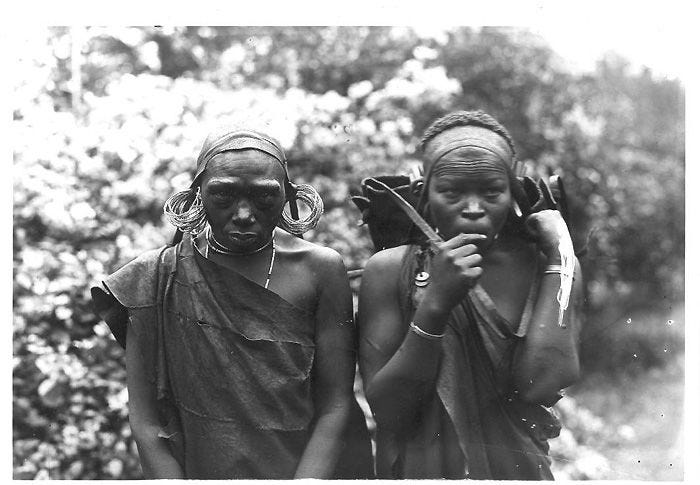
There have been recent debates about the Kikuyu and their sources of wealth. Many believe Kikuyus are generally entrepreneurial in nature which makes them good in business and money matters. There’s even a popular stereotype that suggests Kikuyus love money and that they’ll even steal or murder to get it. Even though I am not sure whether popular beliefs about Kikuyus being murderous are true, I am inclined to believe some of these stereotypes are real. Recent research suggests most stereotypes are fairly accurate even though mainstream psychologists and sociologists deny them. Are stereotypes of the entrepreneurial Kikuyu true or could their sources of wealth be explained by other phenomena?
Subscribe
Critics argue that Kikuyus are not entrepreneurial and that their wealth can be explained by other factors including:
Regional proximity to Nairobi
Proximity of the Kikuyu to power
Enhanced individualism among the Kikuyu (my theory)
This article will explore each of these theories. I will heavily rely on counties as a proxy for ethnicity. For example, when coding data, Nyeri is defined as Kikuyu because they are the majority in that county. The same is true of Kitui for the Kamba, Bungoma for the Luhya, Bomet for the Kalenjin, Siaya for the Luo, Narok for the Maasai, and Kisii for the Abagusii. Some tribes are largely insignificant and you’ll forgive me for “othering” them. For example, I use Coast as a region instead of breaking it into ethnicities. Counties in the coast region include Mombasa, Lamu, Taita Taveta, Tana River, Kwale, and Kilifi. I also use North Eastern to denote Mandera, Wajir, Garissa, and Isiolo. North Kenya is defined by counties like Turkana, Marsabit, and Samburu.
Some counties such as Laikipia didn’t accurately fit ethnic classifications. Some parts of Laikipia are dominated by Kikuyus while other parts are dominated by Maasais and the Samburu. As a result, I use Mt. Kenya to lump together all the GEMA counties including Nakuru not only because they are all closely related to the Agikuyu but also because they vote the same way. As a measure of wealth, I use figures from the Gross County Product (GCP) per capita released in 2018. I also used “www.distance.to” to calculate relative distances of each county from Nairobi. Based on these classifications and data, it will be easy to test some of the theories of Kikuyu dominance in Kenyan markets.
Wealth per ethnic region in Kenya
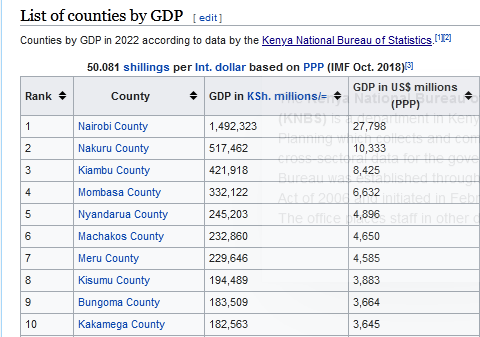
The local version of GDP is the GCP which stands Gross County Product. In 2018, the Kenya National Bureau of Statistics released GCP figures for all counties including Nairobi. You can find the full list on Wikipedia.
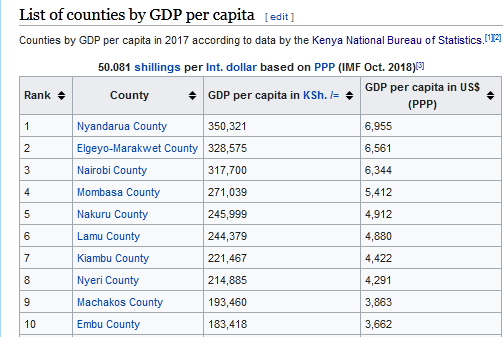
You will also find the GDP per capita figures for each county on Wikipedia. I used per capita figures to avoid the usual pitfalls of absolute GDP figures. On per capita basis, the list changes a little bit and you will notice Nairobi is not at the top anymore. You will also notice the sudden appearance of Elgeyo Marakwet county.
Based on this data, I only needed to group similar counties together and average their per capita GDPs. The average figure would represent the wealth of the ethnic group that occupies that region. The chart below shows the average GDP per capita figures for each ethnic region.
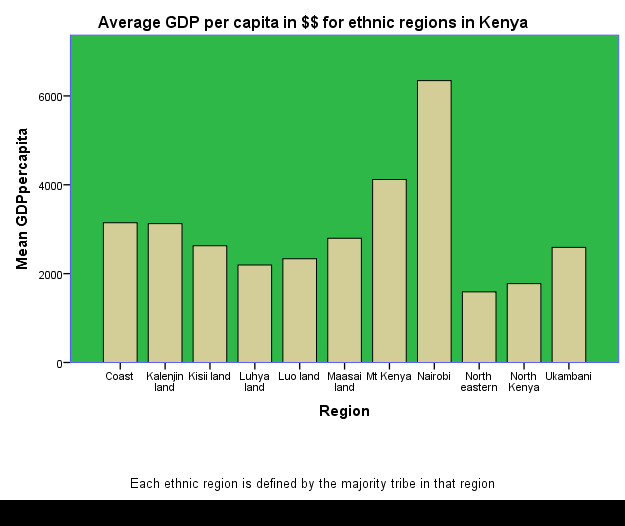
Nairobi is not an ethnic region but it serves as a good benchmark for other regions. The chart proves what we already know; that Mt. Kenya (Nyandarua, Nakuru, Kiambu, Kirinyaga, Murang’a, Nyeri, Laikipia, and Tharaka-Nithi) is the wealthiest region. It is followed by coast, Kalenjin land, Maasai land, Ukambani, Luo land, Luhya land, North Kenya, and North Eastern Kenya. Since these are average figures, disparities within regions might be masked even though the overall trend remains the same.
There’s a huge gap in wealth between Mt. Kenya and other regions and it is this disparity that I seek to explore. Is it that Kikuyus are more entrepreneurial than other ethinicities, or is it because of their proximity to Nairobi? Are Kikuyus closer to power than other groups? Is it true that Kikuyus are highly individualistic?
Kikuyus are Closer to Nairobi
Most critics who believe Kikuyus are not entrepreneurial explain the disparities in wealth by arguing Mt. Kenya counties draw significant advantages due to their proximity to the capital. The idea is that Nairobi confers trade and investment advantages to those counties that are closer to it. The scatter plot below shows the relative distances from Nairobi for all counties and how they relate with GDP per capita.
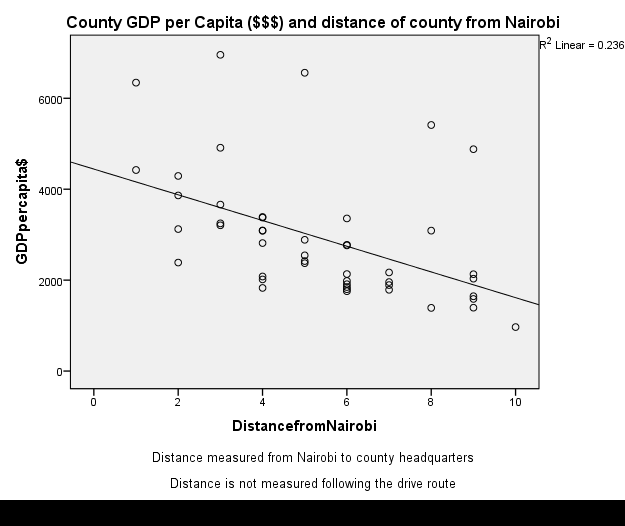
A ten means the county is very far from Nairobi and a zero or one means the county is closer. Mandera is 673 kilometers from Nairobi, Baringo is 234 km, Kiambu is 12 km, Kitui is 192 km, Kwale is 435 km, and Bungoma is 323. From the chart, you can see some counties are very far from Nairobi yet wealthier than some which are closer. These include, Lamu, Elgeyo Marakwet, and Mombasa. Some are closer yet very poor like Kitui which is just 192 km away yet is poorer than Luhya counties with an average distance of 314km and Luo counties with an average distance from Nairobi of 283 km.
The scatter plot also shows a negative correlation (r= -0.49, p=0.001) between average distance from Nairobi and county or ethnic GDP per capita. Correlations range from -1 to 1 with zero denoting no correlation. 1 is a perfect positive correlation while -1 is a perfect negative correlation. In this case, the correlation is negative but moderate meaning countries closer to Nairobi aren’t wealthier than their counterparts in any meaningful sense.
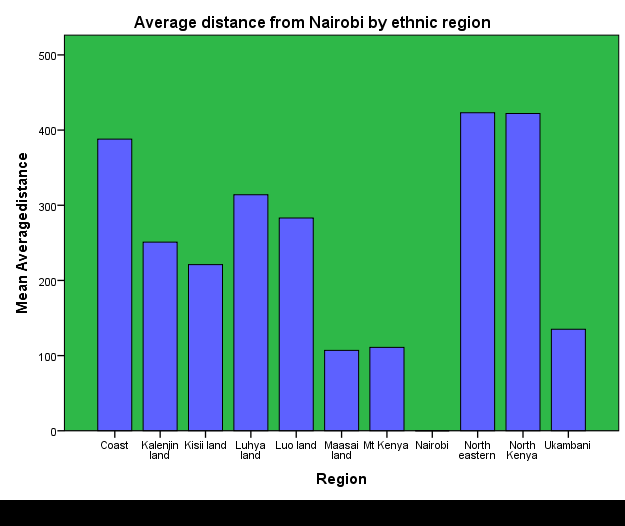
If the theory of proximity to Nairobi were true, we would expect counties such as Kajiado and Narok which comprise Maasai Land to match the wealth of Mt. Kenya. The same would be true of Ukambani where counties like Kitui and Makueni have almost similar distances from Nairobi as Bomet and Kericho yet poorer. One could argue climatic conditions in Ukambani are unfavorable. But would that explain why Kitui (1,829) is wealthier than Migori (1,756) while Makueni (2,080) is wealthier than Bungoma (1,957), Kakamega (1,910), and Siaya (1,891)? Proximity to Nairobi does not seem to explain why Mt. Kenya is wealthier than other regions.
Kikuyus are Close to Power
The first president of Kenya was a Kikuyu, the second who lasted for 24 years was a Kalenjin, the third was a Kikuyu, and the fourth was also a Kikuyu. Cumulatively, Kikuyus have been in power for 35 years. The Kalenjin have been in power for 24 years. If Ruto lasts for another ten years, the cumulative total for the Kalenjin will be 34 years. Since only these two communities have been in power, does that equate to economic growth in some regions and not others?
Testing this theory is much more difficult than the previous one but I believe it is possible to make comparisons and generate credible conclusions. Since Kikuyu’s have been in power the longest, then it is also expected that the Kalenjin would be just as rich or the gap between them would be lower. Second from Mt. Kenya in terms of per capita GDP is not Kalenjin but the coast region. Mombasa and Lamu are wealthier than all Mt. Kenya counties except Nakuru and Nyandarua counties. These regions haven’t been close to power even though one could argue it’s because Mombasa is a city. Kilifi and Kwale which are significantly closer to Mombasa are much poorer. Kisumu which is also a city is poorer than counties like Nyeri, Bomet, Embu, and Elgeyo Marakwet. City-status is, therefore, not a defining factor. In fact, if city status mattered, Nairobi would top the list. Nyandarua and Elgeyo Marakwet are wealthier than Nairobi.
Regions occupied by the Kalenjin are not significantly wealthier than other regions despite being in power for 24 years. The gap between the Kalenjin, the Maasais, and Kisiis is much lower than the gap between Mt. Kenya and all other regions. This implies that proximity to power did not give the Kalenjin any significant advantage that would have widened the gap between them and other communities. If that’s the case, then it is not entirely clear why the reverse would be true for Mt. Kenya.
Some Mt. Kenya counties are also significantly poor than their counterparts which raises questions about proximity to power as the reason for wealth in the region. Murang’a county (3,123) is poorer than Narok (3,206), Kisumu (3.356), Tharaka-Nithi (3,377), and Bomet (3,390). Murang’a is famous for being the home to James Mwangi, the CEO of Equity Bank, the chairman of Equity Bank Peter Munga, Jimnah Mbaru the investment Banker, Benson Wairegi of Britam, Chris Kirubi and others like Gerishon Kirima, and Gerald Gikonyo. All these are Kenyan billionaires from Rwathia, a single village in Kangema, Murang’a county. They are the closest anyone can be to power, yet the county they come from remains relatively poor. Their presence gives credence to the entrepreneur theory of Kikuyu wealth but undermines the theory of proximity to power as a driver of regional growth.
Why the Kikuyus are Wealthy and Entrepreneurial
Politics and geography are all good explainers of why wealth appears where it appears. When trying to understand why some countries are wealthier than others it’s common to evaluate the importance of political and social institutions as well as geography, terrain, climatic factors, and presence of natural resources. The same is true when trying to understand wealth distribution in Kenya where certain political, climatic, and geographic factors come into play and might explain some of the causes of wealth disparities. A more important factor, however, when trying to understand the wealth of nations is the nature of the people and their cultures. People are the drivers of growth and for that reason it is important to look at the Kikuyu cultural evolution and why they are wealthier on average than others.
My discussion in this section is largely theoretical and I intend to use both data, ethnographic findings, as well as anecdotes to drive my points. I believe the Kikuyu are a peculiar group and since they comprise the largest ethnicity in Kenya, each one of us has at some point met and interacted with them. Since I’ve also interacted with them in various capacities, my observations have led me to conclude that they are highly individualistic, less cultured or conservative, mostly liberal, and highly mobile. All these features when brought together help explain why Kikuyus and the Mt. Kenya region is wealthy, and why stereotypes of Kikuyus as entrepreneurs still persists.
No group was influenced by the British in Kenya as much as the Kikuyu. The British mostly settled in Central Kenya and as a result, many Kikuyus were either displaced or had to work in white farms in exchange for money and shelter. The Mau Mau rebellion, which I like to call the Kikuyu Civil War, was also a direct result of settler colonialism and helped fragment relationships between Kikuyus. As some Kikuyus joined the Mau Mau and went to the forest, others took positions as British home guards and retaliated. Thousands from both sides were killed and many others imprisoned. I believe this kind of colonialism foiled social ties and eroded any sense of cultural unity among the Kikuyus, leading to the rise of Kikuyu individualism and liberalism.
In the early years of occupation, Kikuyus practiced Female Genital Mutilation, a practice that many would consider backward and retrogressive by modern standards. However, when British missionaries tried to abolish it many Kikuyus rebelled. Caroline Elkins writes:
In response to missionary pressure, colonial officials in Nairobi altered their typical hands-off approach toward African customs and urged the Local Native Councils in the Kikuyu districts to restrict and regulate female circumcision. By 1929, thousands of Kikuyu were protesting and leaving the established churches to form independent churches and schools, which would permit the practice to continue. This single cultural issue mobilized the Kikuyu peasants for the first time and, in so doing, provided the Kikuyu Central Association (K.C.A) with a mass political base.
The British were relentless in their coercive means and in the years that followed, the Christianization of the Kikuyu population as well as the rooting out of retrogressive cultures such as FGM increased. Moreover, in a bid to escape the wrath of the British and to dissociate with the Mau Mau, many Kikuyus embraced Christianity and let go many other traditional cultures. I believe this was advantageous drawing from the the effects Christianity has had on culture and wealth in other countries. Joseph Henrich writes of the Weirdest People in the World in reference to the rise of Europe as an economic and cultural hegemony. One reason that led to the rise of Europe relative to the other regions of the world was medieval Christianity which de-emphasized certain cultural practices such as incest and polygamy.
Subscribe
With laws against incest and polygamy, it became easier for men to get wives. In polygamous and incestuous cultures, few males control all the females and it becomes unlikely that young men will get wives. As a result, young males are unlikely to work hard and maintain the peace, all which are necessary for wealth creation. The church’s Marriage and Family Plan, argues Henrich, promoted hard work and peace then increased mobility among Caucasians since marrying relatives and close neighbors wasn’t allowed. I believe the same can be said of the Kikuyu. After being assimilated into Christianity, such practices as female genital mutilation, arranged marriages, polygamy and incest declined relative to other ethnic groups. Christianization also reduced the power held by elders. Instances of arranged marriages and allocation of wealth in families using formulas (such as the House Property Complex discussed below) aimed at controlling wealth distribution as observed among Muslims and Indians is evidence of the presence of powerful elders. These elders limit growth, economic activity, and entrepreneurship by controlling wealth and resources in the family.
The British occupation of Central Kenya therefore pushed Kikuyus out of their lands and prompted them to seek alternative lives different from what they were used to. Their presence in many different counties in Kenya is evidence of this fact. Many others converted to Christianity and would endeavor to develop views that are consistent with modern liberal societies. Most of these views are consistent with economic growth and wealth creation. Luckily, this proximity to the British and the Christian missions would also put the Kikuyu closer to schools making Mt. Kenya the most literate region in the country.
The interplay of British colonialism and Christianity made the Kikuyu highly individualistic as most of their social ties were severed. Displacement from their lands also pushed them to other regions in search for opportunities making the Kikuyu a highly mobile group. If this explains their wealth then it can be argued that the reverse makes other communities poor. For example, we can ask how much polygamy affects wealth creation in the communities that practice it or the role of FGM, wife sharing, and incestuous relationships have on economic growth.
One thing that is notable about the Kikuyu is their low fertility rate; the lowest of all ethnic groups in Kenya. A Kikuyu woman is expected to have three children in her lifetime while most ethnic groups will average seven to eight children. High fertility rates can be traced to the prevalence of polygamy, wife sharing, and wife inheritance in certain ethnicities. Yasuko Hayase and Kao-Lee studied polygamy in Senegal, Kenya, Ghana, and Zimbabwe using DHS and health survey data. They observe polygamy in each of these nations was characterized by low education in women, low education among men, Islam, and low urbanization.
Subscribe
In Kenya, polygamy among women with no education was 33% while the rate among those who had completed secondary education was lower at 11.1%. Observed proportion of polygamy in uneducated men was 38.1% and 15% for those who completed secondary school. Muslims were more likely to be polygamous (28.9%) than Christians (21.1%). Rural areas were more polygamous (24.1%) than urban areas (17.5%). What this evidence reveals is that polygamy is not a practice you’d expect to find in highly educated and modernized regions. It is a preserve of uneducated and mostly Islamic countries and ethnicities. Based on these data alone, we can infer that the Kikuyu are less polygamous since they’re likely to be educated, live in urban areas (proximity to Nairobi), and be Christian. This is what we see from the data where proportion of polygamy in Kikuyu was 8.9% compared to Kalenjin/ Kamba/ Meru/ Embu (18.1%), Kisii and Luhya (25.4%), Luo (32.6%), Mijikenda and Swahili (39.4%).
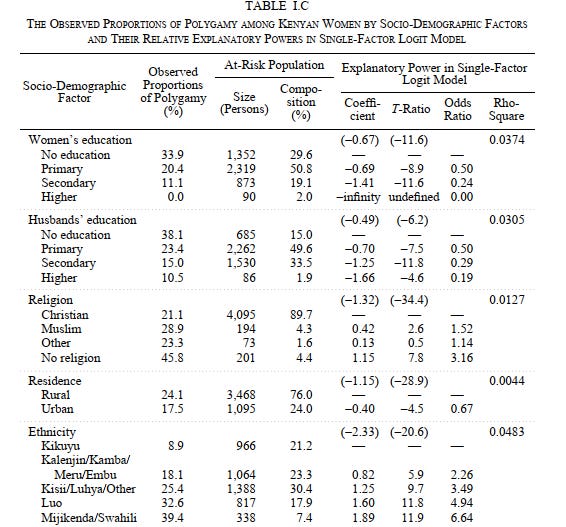
According to the authors, polygamy among the Kikuyu is lower than the national average of 23%. Low fertility rates coupled with higher literacy in Mt. Kenya region explains why wealth concentration is likely to happen. As Gregory Clerk has argued of the industrial revolution in England, it was demography and institutional stability that favored industrial growth in the region. Specifically, it was the slow growth of the English population coupled by the fecundity of the wealthy and successful. High fertility is inconsistent with economic growth since any economic gains are always wiped out by the extra mouths that need feeding. Such has been the tragedy of highly fertile groups such as Luo, Luhyas, Kalenjins, Cushites, and coastal Bantus. A glimpse of modern Nyanza and Western shows these regions have very high population densities but also happen to be less mobile. A large majority of the people would rather build homes in their ancestral villages than buy plots in other regions and build houses.
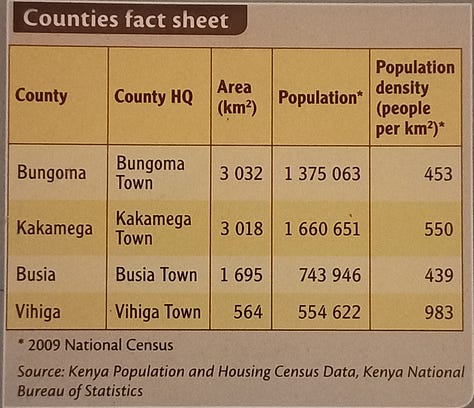
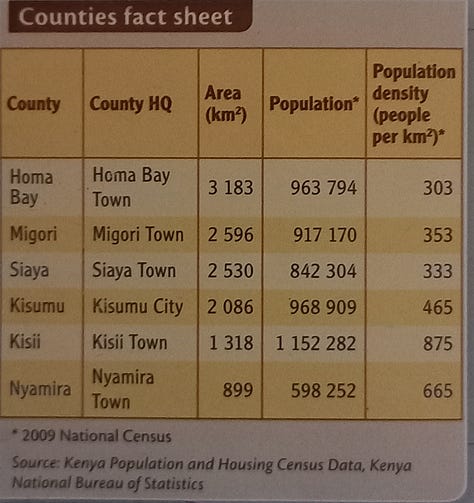
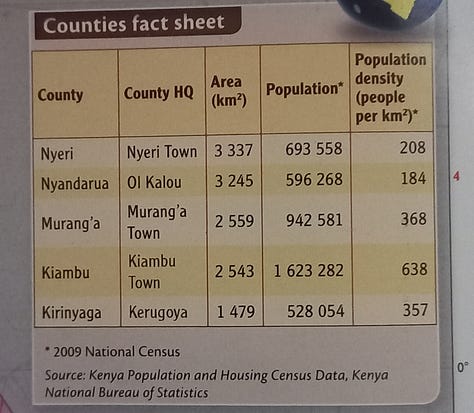
Population densities of Western, Nyanza, and Central
The prevalence of witchcraft and magical beliefs in many ethnic regions also sheds light on how culture affects economic growth and wealth creation. For example, witchcraft tends to go hand in hand with polygamy. A study by Robert Levine exposes this nocuous relationship in an exploration of co-wife proximity and witchcraft among the Abagusii, Luo, and Kipsigis. Levine argues that in many societies, jealousy among co-wives is quite prominent and the Abagusii even have a term for it, engareka, which means “hatred between co-wives.” As a result, many wives and co-wives always accuse each other of witchcraft and sorcery, a practice that might undermine wealth accumulation since the only way of reducing co-wife hatred is by creating distance between them.
The Gusii believe the jealousy between co-wives can be held in check by placing their separate houses as far apart as possible, to diminish opportunities for the friction of social contact. This folk belief suggests the hypothesis that the closer co-wives live to one another, the greater the frequency of witchcraft attribution and
sorcery in community life.
The Luo, the Abagusii, and the Kipsigis all differ in how close co-wives are allowed to be and as a result, the prevalence of witchcraft accusations also differ among them. Among the Luo, co-wives live separately yet too close their huts could touch. The Luo, therefore, tend to have a very high incidences of witchcraft. Co-wives among the Abagusii live closer to one another but there’s considerable space between them, with houses built further apart from each other. Accusations of witchcraft are high but not as much as the Luo. Co-wives among the Kipsigis live far apart in different kraals. The husband sends each wife with her elder son to distance locales where they live and take care of the cows allocated to them by the husband. Accusations of witchcraft are lower than those of the Abagusii and Luo.
According to Levine, this relationship between witchcraft and polygamy is facilitated by a “house property complex” where wealth is only owned by men and is passed down to the first born sons of each wife. “This creates within domestic groups, mother-son subgroups called “houses” which compete with each other for a larger share of the property to be inherited by the respective sons.” I believe it’s difficult for wealth to grow in settings where members of the same family compete for the same resources. I also believe this might explain why despite the high population densities in South Western Kenya, these groups rarely move out due to the ties they have to ancestral property, jealousy between families, and the accusations of witchcraft which reduce incentives for hard work and wealth accumulation.
The Kikuyu have a dual advantage for being monogamous and not believing in witchcraft. Polygamy breeds hatred and creates unnecessary competition between co-wives. On the contrary, monogamous relationships emphasize unity between the husband and the wife and wealth is often distributed to all children in the family or at least, to the male children of the same family. Witchcraft on the other hand is not only a sign of low intelligence but is also a catalyst of strenuous relationships within ethnic groups, promotes social distrust, and reduces hard work and wealth accumulation.
Critics often argue that the matrilineal nature of Kikuyu societies is a social disadvantage. However, if Levine’s “House Property Complex” observed in patrilineal societies is to go by, then it can be argued that the former empowers women and allows them to participate fully in the economy while patriarchal ethnicities try to control sex and marriage through FGM, wife inheritance, wife-beating, and polygamy. All these lead to lower market participation by women, increased poverty, and low wealth accumulation. The result is that, Kikuyu women will be more assertive, liberal, out-going, educated, and economically empowered compared to their counterparts from other ethnicities who are docile and submissive. If you’ve met a Luhya man in the city, chances are he’s left his wife back in the village. Kikuyus on the other hand rarely leave their wives in the village. They live and work together wherever they are increasing their household incomes which they use to start businesses and buy property.
To sum, the fact that Central Kenya is wealthy seems to have nothing to do with proximity to the capital or proximity to power. Culture and the organization of Kikuyu families and societies best explains the wealth difference between them and other ethnicities. The Kikuyu are largely individualistic, liberal, and non-traditional - traits they might have developed from interactions with Europeans from as early as the 1920s. However, some accounts emphasize the uniqueness of the Kikuyu in earlier periods. Geoffrey Muriuki writes in A History of the Kikuyu to 1904 that Kikuyus were good in agriculture and that their cultivation was “prodigiously extensive.” In the 1890s, all Kikuyu regions were under tillage and beans and other grains were in abundance even though locusts and drought had previously ravaged the community. The author also observes “the description of the Kikuyu land in 1890 shows that the Kikuyu had penetrated, deforested, cultivated up to their present boundary.” Whether the Kikuyu had the peculiar characteristics I’ve listed before European colonization is subject for debate. What can’t go unnoticed, however, is that the tribe has lower fertility rates, lower incidences of polygamy, and lower witchcraft. In contrast, they are highly literate, mobile, and Christianized. All these form the recipe for wealth creation and accumulation.
Discussion
Be the first to leave a comment. · Replies from Author appear in thread.